Padrón Cigars: The Complete Guide — A Morning with Jorge Padrón in Estelí
By Michel Besson, Fine Cigars Club — written after a morning and lunch with Jorge Padrón at the Padrón factory in Estelí, Nicaragua, January 2026

There are cigar factories you can tour, and there are cigar families you can meet. In January 2026 I was fortunate enough to do the latter — spending a morning, and then lunch, with Jorge Padrón, president of Padrón Cigars and son of the late, legendary founder José Orlando Padrón, at the family's factory in Estelí, Nicaragua. We talked through the family's history in his office, he showed me how a blend begins, and over lunch at a Cuban restaurant he generously shared two of the finest cigars his company makes. This guide is written from that morning — the history, the philosophy, the cigars — by someone lucky enough to have heard much of it from the family itself.
The History of Padrón: From Cuba, to Miami, to Estelí
Padrón is, at its heart, a Cuban story that found its home in Nicaragua.
The family's tobacco roots run back to 19th-century Cuba, where José Orlando's grandfather, Damaso Padrón — who had come from the Canary Islands — planted his first tobacco crops and began a family tradition of growing leaf. (That name endures today in the Padrón Dámaso line.) Tobacco, and a rigorous devotion to quality, was in the family's blood for generations before a single "Padrón" cigar was ever sold.
Then came the revolution. After Castro's government seized the family's tobacco farms, José Orlando Padrón fled Cuba, arriving in Miami with almost nothing. Working carpentry jobs by day, he saved $600 and, in 1964, founded his cigar company in Little Havana — rolling in the traditional Cuban style, with a single roller, for a local audience of fellow exiles.

The little hammer
One of the first objects José Orlando was given in Miami was a small hammer — el martillito — a gesture of solidarity from a friend, symbolising the idea of building something from nothing through hard work. It became the family's talisman, and to this day the little hammer appears in the Padrón logo — a reminder, on every box, of a man who started with $600 and his hands. Jorge told me the story himself; it is the kind of detail that tells you what this family values.

Why Nicaragua
As Padrón's Miami cigars grew popular, José Orlando found that the Connecticut tobacco he was using cured slowly and limited him. The turning point came when he tasted Nicaraguan tobacco — a revelation, he later called it. He recognised that a particular valley around Estelí shared an almost identical microclimate and soil with Cuba's fabled Pinar del Río. In 1970 he moved production to Estelí, and Nicaraguan tobacco changed the company's history. Padrón has been rooted there ever since.

Survival, and principle
The Padrón story is also one of extraordinary resilience. In Miami, because José Orlando had controversially negotiated with the Cuban government to secure the release of political prisoners, anti-Castro hardliners branded him a traitor — and the family's Miami premises were bombed three times between 1979 and 1983. In Nicaragua, the family weathered the Sandinista upheaval, a US embargo (which briefly forced production to Honduras), a farm seizure, and the devastation of Hurricane Mitch in 1998. Through all of it, José Orlando never compromised on the cigars. His test for a cured leaf was famously to press his face into it and breathe in; if it passed, he would say simply, "Tiene buena nariz" — "it has a good nose."
Quality, Not Quantity: The Padrón Philosophy
The single most important thing to understand about Padrón is carved, quite literally, into the bust of José Orlando at the factory entrance: "Produciendo calidad y no cantidad" — producing quality, not quantity.
This is not a slogan; it is the operating principle of the entire company. Padrón deliberately remains a relatively small producer — around six million cigars a year — a fraction of the output of the industry's giants. The family could make far more. They choose not to, because scale and quality pull against each other, and quality always wins. Every stage is vertically integrated and family-controlled — they grow their own tobacco, ferment it, age it (holding years of reserves), roll it and box it — so that nothing leaves Estelí that hasn't met the family's standard.

It is, still, a family business in the truest sense — three generations, with Jorge now carrying his father's legacy and his own son alongside him. That continuity is a large part of why the cigars are so consistent: the standard is not written in a manual, it is handed down.
Inside the Factory: What I Saw in Estelí
Spending the morning on the floor with Jorge, you see how completely the "seed to smoke" philosophy is lived.
It begins in the field and the curing barn. Fresh green leaves come in from the Estelí fields and are hung in the curing barns, where over weeks they turn from green to golden-brown — the first transformation, before any fermentation begins.

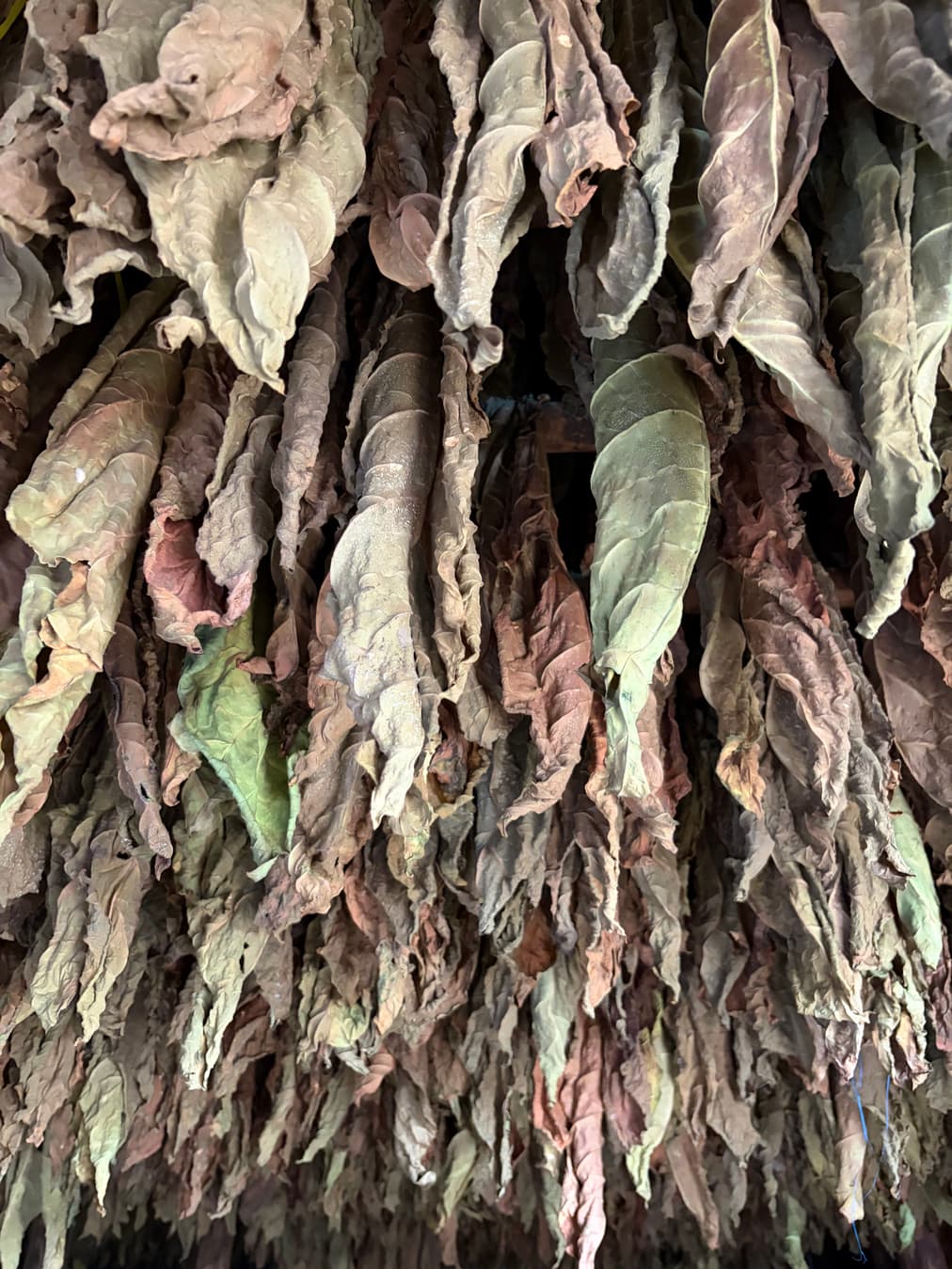
Fermentation — including the mojadores. The cured leaf is then fermented, the stage that develops flavour and smoothness and removes harshness. I watched the mojadores at work — the workers who dip the leaves in water during fermentation, controlling the moisture that drives the process. It is careful, physical, deeply traditional work.

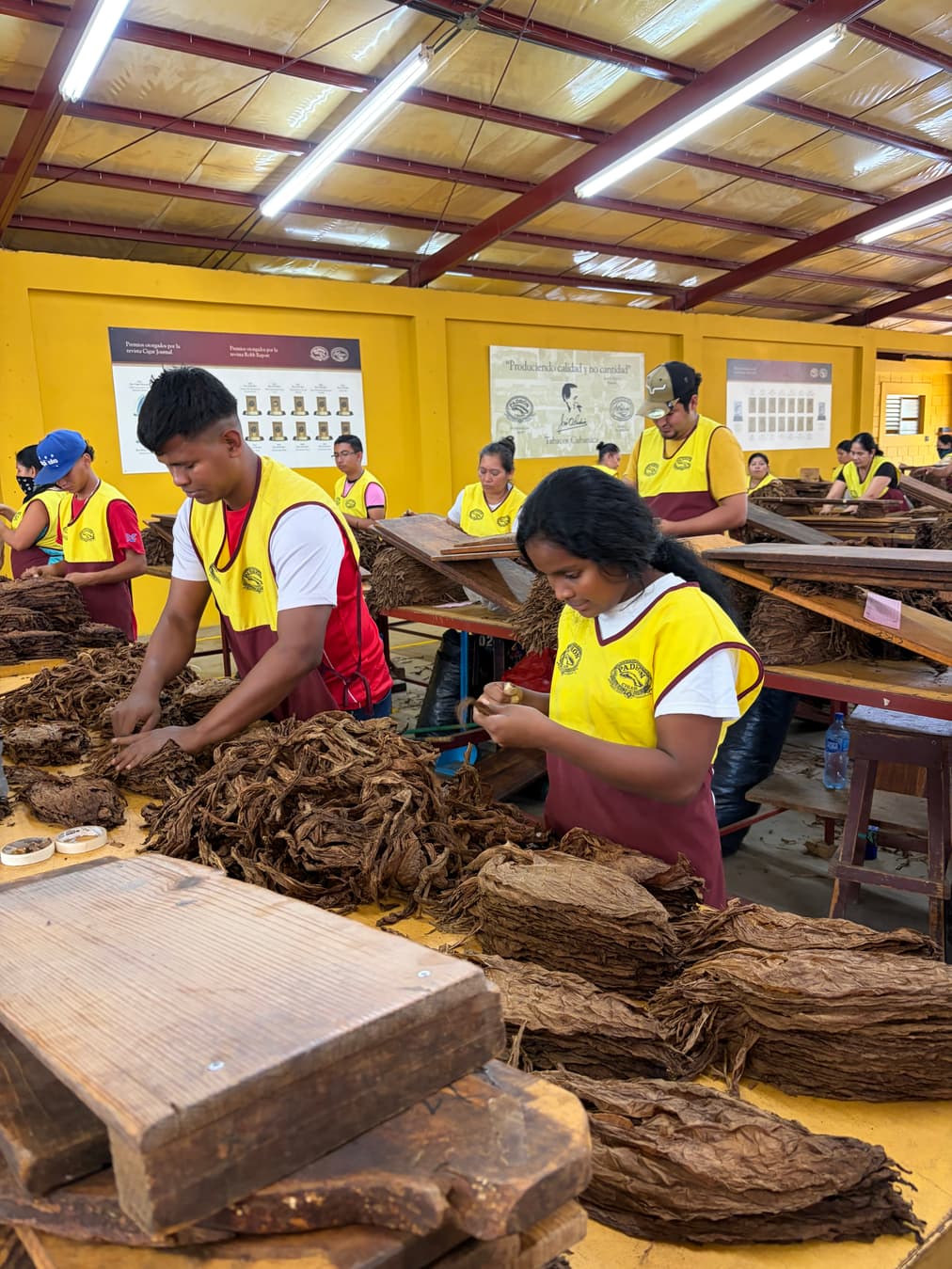
Sorting and drying. Workers sort the leaves from the bales by hand, grading them for their place in the blend, and binders are rested in their own drying room before rolling.

How a blend begins — from Jorge's own hand. The moment that stayed with me most: Jorge showing how a blend starts by taking a single fermented leaf — it might be a wrapper, a binder or a filler — rolling it on its own, lighting it, and smoking it, to understand exactly what that one leaf contributes before it ever goes into a blend. To watch the president of the company read a single leaf by smoking it is to understand how this family thinks about tobacco.

A Record Five Cigars of the Year
Here is the statistic that puts Padrón in a class of its own: the brand has won Cigar Aficionado's coveted #1 Cigar of the Year a record five times — more than any other maker in the award's history. The wins span the 1926 Serie and the 1964 Anniversary lines across the years — the most recent being the 80th Anniversary, named Cigar Aficionado's #1 Cigar of 2025, a distinction I heard about at the source, days into its glory.

The great anniversary lines are the heart of the range:
- Padrón 1964 Anniversary Series — launched in 1994 for the company's 30th anniversary; the box-pressed, Nicaraguan-puro brand that brought Padrón national fame and, in Jorge's words, "brought back" the box press.
- Padrón 1926 Serie — introduced in 2002 to mark José Orlando's 75th birthday (he was born in 1926); richer and fuller still, and the source of multiple Cigar-of-the-Year wins.
- The Anniversary editions — the 80th (Cigar of the Year 2025) and 60th among them, the pinnacle of the family's craft.
Over lunch at a Cuban restaurant, Jorge kindly shared with me the 80th and 60th Anniversary cigars — the very best in the portfolio, the 80th being the reigning Cigar of the Year. To smoke those cigars, in that company, having spent the morning learning how they are made, is an experience I will not forget.

What Defines the Padrón Taste
Padrón cigars are Nicaraguan puros — made entirely of Nicaraguan tobacco — and they are renowned for being rich, full-flavoured and impeccably smooth. The house signature is a deep, savoury profile: cocoa, coffee, earth, black pepper, leather and a distinctive nutty sweetness, with the Maduro versions adding dark chocolate and a rounder sweetness over the Natural's brighter, spicier edge. Above all, Padróns are famous for balance and consistency — the product of aged tobaccos, meticulous fermentation and that refusal to chase volume.
Most of the celebrated lines are box-pressed — the squared-off shape the 1964 Anniversary helped bring back — which many smokers feel concentrates the flavour and gives a slower, cooler burn.
The Padrón Range We Stock
We carry a selection of genuine Padrón cigars, spanning the family's core and anniversary lines.
Padrón 1964 Anniversary Series Principe

The line that made Padrón famous, in its most time-friendly size. The 1964 Anniversary Series Principe is a compact, box-pressed Nicaraguan puro measuring 4½" × 46, hand-made from sun-grown Nicaraguan tobaccos aged four years, and finished with the individually numbered band that guarantees a genuine 1964. Cigar Aficionado scored the Principe 93 points, describing the series as pouring "creamy, cappuccino-like smoke onto the palate, along with the brand's signature notes of refined milk chocolate." A 30–40 minute cigar that gives up nothing to its bigger brothers.
Padrón Series 2000 Maduro Robusto

The perfect introduction to the house. The Series 2000 Maduro delivers the classic Padrón profile — cocoa, coffee, earth and a dark, smooth sweetness — from the brand's excellent-value core line. If you want to understand why the world reveres Padrón without reaching for the anniversary prices, start here.
You can browse the full range on our Padrón collection page.
Which Padrón Should You Choose?
If you're new to Padrón — start with the Series 2000 Maduro. It's the classic house flavour at an accessible price, and one of the best-value premium cigars you can buy.
If you want to understand the legend — seek out the 1964 Anniversary (box-pressed, the cigar that made the name) or the fuller 1926 Serie (a multiple Cigar of the Year).
If you want the pinnacle — the Anniversary editions, including the 80th (Cigar of the Year 2025), are among the finest cigars made anywhere.
If you love rich, smooth, full-flavoured cigars — Padrón is essential. Those who enjoy it should also explore our first-hand My Father guide, another great Estelí house, and our Oliva guide, which follows Nicaraguan tobacco from seed to bale in the Condega fields. For where the Nicaraguan industry began, read our guide to Joya de Nicaragua. There is more of the trip in our Nicaragua TOR Tour 2026 account.
How to Spot Genuine Padrón Cigars
Padrón is one of the most counterfeited premium brands, so buy with care:
- The serial number. Since 2001, genuine Padrón anniversary and Family Reserve cigars carry an individual six-digit serial number on the band — a key anti-counterfeiting measure. Padrón also uses a guarantee seal on boxes.
- Buy from a reputable source. We source our Padrón through official channels — genuine stock, correctly stored.
- Check construction and price. Genuine Padróns are superbly made and box-pressed on most lines. Suspiciously cheap "Padróns" are the commonest sign of a fake.
Frequently Asked Questions
Who founded Padrón, and where are the cigars made? Padrón was founded in 1964 in Miami by José Orlando Padrón, a Cuban exile, with $600 saved from carpentry work. In 1970 he moved production to Estelí, Nicaragua, where the family — now led by his son Jorge Padrón — still makes all its cigars from 100% Nicaraguan tobacco, fully vertically integrated from seed to box.
Why is Padrón considered so special? Two reasons above all: an uncompromising "quality, not quantity" philosophy (they deliberately produce only around six million cigars a year, a fraction of the giants), and an unmatched record — Padrón has won Cigar Aficionado's #1 Cigar of the Year a record five times, more than any other brand. The cigars are prized for their richness, balance and remarkable consistency.
What does the little hammer in the Padrón logo mean? It represents el martillito — a small hammer given to founder José Orlando Padrón in his early Miami days, symbolising building something from nothing through hard work. It became the family's emblem and appears in the Padrón logo to this day.
Are Padrón cigars strong? They're full-flavoured and rich but famously smooth and balanced rather than harsh — cocoa, coffee, earth, pepper, leather and a nutty sweetness. The Maduro versions are darker and sweeter; the 1926 Serie is at the fuller end. Aged tobacco and meticulous fermentation give them their smoothness.
What's the difference between the 1964 Anniversary and the 1926 Serie? The 1964 Anniversary (launched 1994, for the 30th anniversary) is the box-pressed line that made Padrón famous nationally. The 1926 Serie (2002, marking José Orlando's 75th birthday) is richer and fuller still. Both are Nicaraguan puros, both box-pressed, and both have won Cigar of the Year.
How can I tell a genuine Padrón anniversary cigar? Genuine Padrón anniversary and Family Reserve cigars carry an individual six-digit serial number on the band, introduced in 2001 to combat counterfeiting, and boxes carry a guarantee seal. Buy from a reputable source and be wary of prices that seem too good to be true.
Explore our full range of Padrón cigars, read our first-hand My Father guide and our Nicaragua TOR Tour 2026 account, or browse our flagship Cuban guides to Cohiba, Montecristo and Partagás.